A two-inch trigger, a place on the route and a season price — and the six local things that decide what that price is, from the surface of the drive to who plows the road it opens onto.
The plowing, shoveling and salting arranged through this page is done by an independent snow removal operator under their own business name and their own insurance. This site makes the introduction and clears nothing itself.
A seasonal driveway contract in the Barrington area is a trigger depth, a route position and a season price. The trigger is almost always two inches — the same depth Barrington and Deer Park use for their snow parking bans. When accumulation reaches it, the operator comes without a call, clears the driveway and the apron, and moves to the next property on the route. The season runs roughly from the first week of December to the third week of March, which matches the normal first and last one-inch snowfall (December 7 and March 20 at O’Hare).
What it leaves out unless the contract says otherwise: the windrow the public plow leaves across the apron an hour later, the walk to the side door, salt, and any storm that falls before the start date. Every one of those is a separate line, and every one of them comes up in January. The point of asking in October is that they are cheap then.
Not twenty. The NOAA normals for the Barrington 3SW station put a typical winter at 12.6 days with an inch or more and 4.6 with three inches or more, so a two-inch trigger brings a plow somewhere between six and a dozen times, one or two of them for a storm that matters. A 2024–25-type winter, 17.6 inches at O’Hare, might bring it four times. A 2020–21-type winter, 48.8 inches, might bring it fifteen.
That is the honest basis for a seasonal price here, and the reason it should be understood as insurance against the big year and a place on the route on the big morning, not as a discount on volume. It is also why the published per-visit tables matter: a zero-tolerance per-visit contract comes on every one of the season’s ~25 measurable-snow days, pre-salts ahead of forecasts, and runs a single driveway to roughly $2,000 in a normal winter on the area’s largest advertiser’s own numbers. The three products compared.
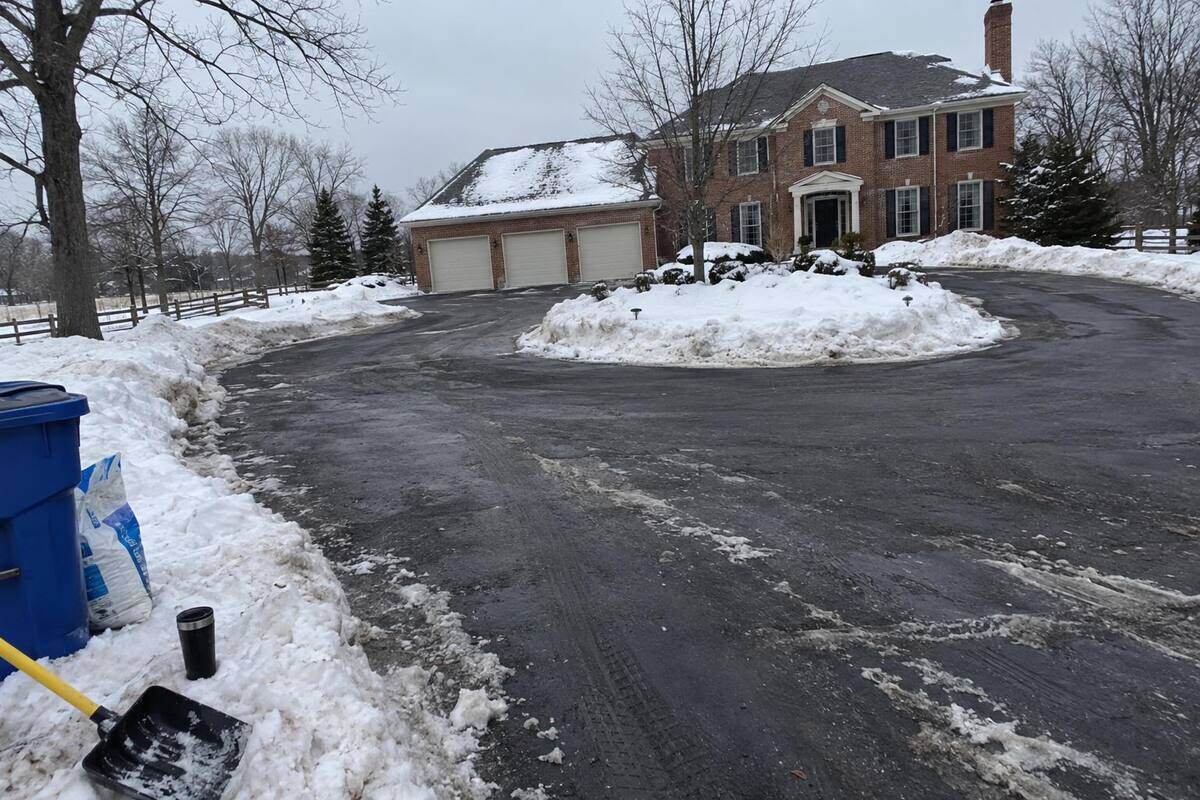
A 60-foot drive on a Barrington town lot is a three-minute pass. A 300-foot approach with a circle in Inverness is a different job, with a different place for the snow to go each time. Long driveways.
Asphalt takes a blade. Pavers take a blade with the shoes up and a stake at every edge. Crushed stone — legal in Inverness, banned in South Barrington — takes a raised blade or a blower. Say what it is.
A driveway on a Cuba Township route in South Barrington gets a windrow up to four hours after the private plow leaves. One on a Barrington Hills private lane gets no public windrow at all, because no public plow comes. Who plows your road.
Not on the street anywhere; in Inverness that is a $200–$750-a-day fine on the homeowner and the operator jointly. Not against a hydrant, a sight line or a parkway tree in Barrington. Not over the wellhead or the septic field on a one-acre lot. The rules.
Barrington’s code says the village plow may push snow in front of a cleared driveway and will keep widening the street. Whether a return pass is in the season price is the single most important line in the contract. The windrow.
January averages 21°F here and rock salt’s practical floor is 15–20°F. Whether the contract pre-treats with brine, salts after the plow, or leaves ice control out entirely is a separate price and a separate question, especially on a well. Salting near wells.
Frost depth in these villages is 42 inches. Once the ground is hard, a stake does not go in and a paver edge does not forgive. Before the first plowable snow the operator should mark the driveway edges, the apron corners, the culvert ends where the drive crosses the roadside ditch (the estate villages are ditch-and-culvert, not curb-and-gutter), the mailbox post, any sprinkler heads near the drive, and the edge of any paver or stone border. On a gated drive, the gate posts and the swing radius. It takes an hour in November and saves a spring of repairs.
One more thing to settle in November: which side of the drive the snow gets piled on. Pile it on the right as you face the road and the public plow’s next pass carries it away from the apron. Pile it on the left and the plow brings it straight back.
Which village, what the driveway is like, and what else needs clearing. An operator who already runs that village will quote it in writing.
Call (224) 655-5981 Get a Seasonal Quote Barrington