January averages 21°F here, at the bottom of rock salt’s working range, and seven villages drink from the same shallow aquifer. De-icing in the Barrington area is a question of what, when and where — not how much.
The plowing, shoveling and salting arranged through this page is done by an independent snow removal operator under their own business name and their own insurance. This site makes the introduction and clears nothing itself.
Outside Barrington village almost every house in this area is on a private well. Barrington Hills: “Most homes in the Village have private wells and septic systems.” North Barrington: wells and septic “except for the Wynstone area.” South Barrington: wells and septic except The Regency, The Woods and Village Enclave. Deer Park: private wells except the Rand Road triangle. Inverness: septic by code, with parts on Barrington water. And the Barrington Area Council of Governments, which speaks for all of them, says the whole region — municipal systems and private wells alike — draws from one interconnected shallow aquifer.
That is why the villages talk about road salt the way they do. Barrington Hills’ Winter 2022 newsletter: “chlorides are carried to the aquifers where they stay indefinitely in the groundwater – the same water we drink,” and “it only takes 1 teaspoon of salt to permanently pollute 5 gallons of water.” North Barrington tells residents it deliberately restricts salt on its streets because “overuse of salt… may lead to groundwater contamination.” Barrington runs a liquid anti-icing program to cut salt use; Lake Barrington pre-treats with a brine and calcium chloride blend. The Upper Fox River and Flint Creek watershed, which drains these villages, carries a chloride listing on one of its segments.
Rock salt works by making brine, and brine needs warmth. The practical floor is about 15 to 20°F; at 10°F it takes an hour for salt to melt an eighth of an inch of ice. The Barrington 3SW station’s January mean is 21.1°F and its nights run well below that, which means a good share of January salt in these villages does very little except reach the ditch, the creek and eventually the well. Calcium chloride keeps working below zero; liquid brine applied before the snow keeps it from bonding to the pavement so less of anything is needed afterward. Every one of the villages that plows its own roads has moved toward liquids for exactly that reason.
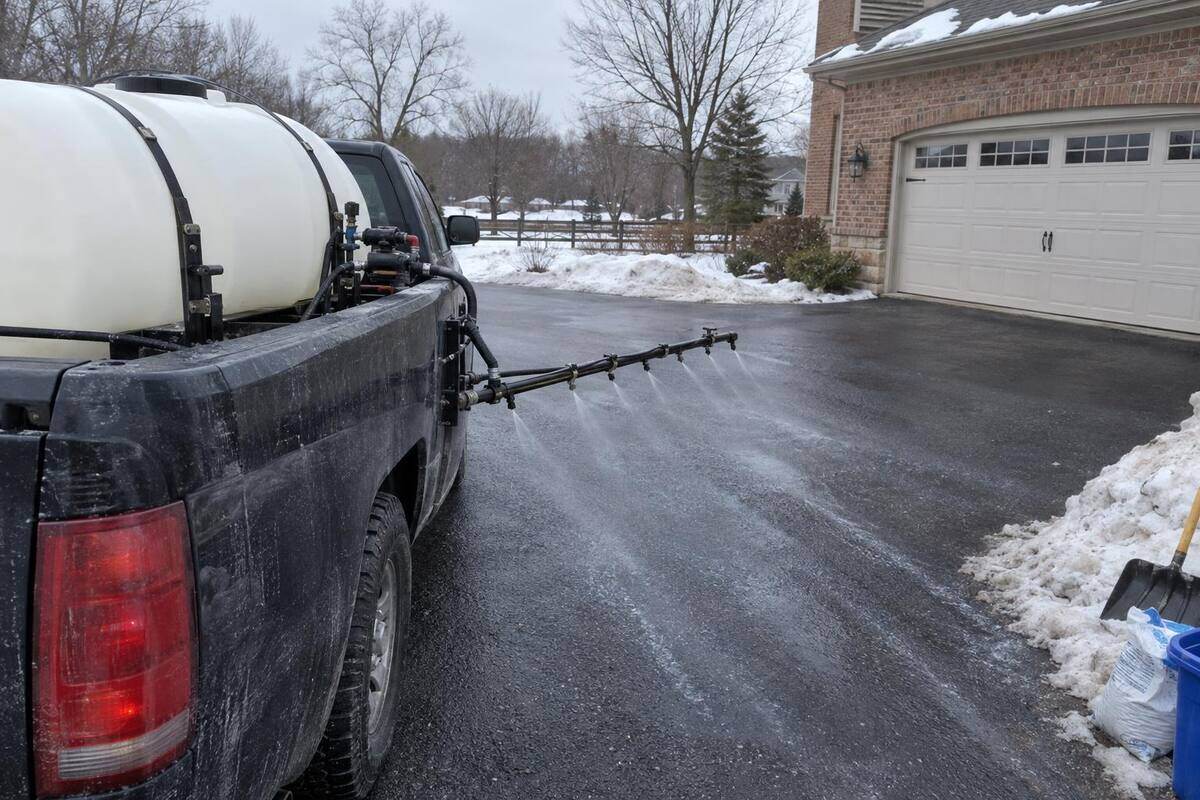
Applied ahead of a forecast storm, a liquid brine keeps the first inch from bonding. The plow then takes the snow to bare pavement instead of to packed ice, and the salt applied afterward is a fraction of what an untreated surface needs.
Salt is for the film that is left, not for the storm. A spreader calibrated for a driveway uses a fraction of what a hand-thrown bag does. The Lake County practice guides say it plainly: more is not better, and sweep up what is left.
The operator should know where the wellhead is and where the septic field runs, and neither the salt nor the melting pile should sit over either. That is a sentence in the contract, not an assumption.
Barrington Hills pays its road contractor for salt separately, at cost, and a homeowner should expect the same clarity: a pre-treatment price, a post-plow salting price, and the product named. Pet-safe and low-chloride melters cost more — the area’s largest advertiser adds 25% for one. Contractors can also train and certify under the Salt Smart Collaborative, a program backed by Lake County’s transportation, health and stormwater agencies, which requires calibrated spreaders and per-event records; Lake County runs winter workshops for private contractors every fall. It is fair to ask an operator whether anyone on the crew has taken one.
What is not true, despite what some trade blogs say: Illinois has no certified-applicator law that shields a contractor from slip-and-fall liability for using less salt. That exists in New Hampshire and Colorado. Here, the incentive to use less is the well.
Which village, what the driveway is like, and what else needs clearing. An operator who already runs that village will quote it in writing.
Call (224) 655-5981 Get a Seasonal Quote Barrington