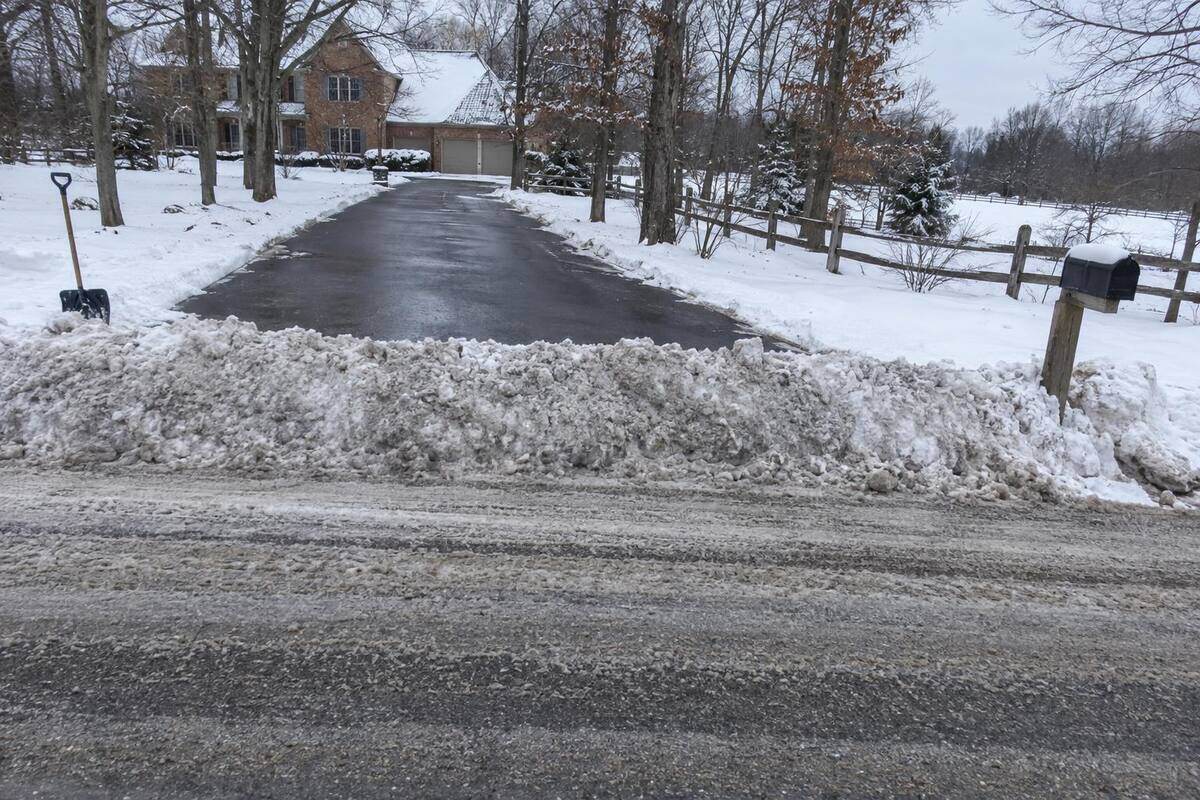
The public plow comes through an hour after the driveway is done and leaves a ridge of road-packed snow across the apron. Every village and township here says in writing it will not come back for it. Whether your contract does is the question.
The plowing, shoveling and salting arranged through this page is done by an independent snow removal operator under their own business name and their own insurance. This site makes the introduction and clears nothing itself.
Every homeowner on a plowed road knows the sequence. The private operator clears the driveway at 5 a.m. The village or township truck comes through at 9, and the blade, angled to the right, leaves a ridge of dense, road-packed snow across the apron — the windrow. It is heavier than anything that fell from the sky, and in this area it will still be there a week later, because the station records snow on the ground 64 days a year.
What makes the windrow different in the Barrington villages is that the public plows say, in writing, that they will not come back for it.
Its snow and ice page says that during operations “plows may push snow in front of your already cleared driveway,” advises waiting until the street is completely plowed, and adds that “plows will continue to widen cleared areas” — meaning a second windrow after the first. No return pass for aprons is offered anywhere on the page.
“There is no practical way for the snow plow operator to cut off the wind row of snow when crossing a driveway.” Cul-de-sacs take 20 to 30 minutes each, and the township asks residents not to push snow back into a plowed street.
“A typical route takes up to 4 hours” — which is how long after the private plow leaves that the windrow can arrive. Pushing driveway snow into the right-of-way is prohibited, and a 35-foot plow truck limits what a cul-de-sac can hold.
Main roads first, secondary roads next, cul-de-sacs last; “if needed, a smaller truck will be used to finish removal on a cul-de-sac the following day.” Cleanup runs six to eight hours after the storm winds down. Two windrows, a day apart, is a normal cul-de-sac winter.
This is the single line in a seasonal contract that decides whether the driveway is actually cleared. Three ways operators handle it:
None of these is wrong. Not knowing which one you bought is. Get it in writing in October, and get the price of a return pass in writing even if it is included, so a February argument has a number in it.
The free version: pile the snow you shovel yourself on the right side of the drive as you face the road. The public plow’s blade throws right; snow on the left comes straight back across the apron on the next pass.
On Barrington Hills’ 24.5 miles of private road, in Wynstone, on a South Barrington association street or in Lake Barrington Shores, no public plow comes and no public windrow forms. Instead the association’s contractor plows the road, and whether that contract touches the driveway or its apron is a question for the association. On a private road the windrow conversation is between two private contractors, and the homeowner is usually the one who has to have it. Private roads and HOA streets.
Which village, what the driveway is like, and what else needs clearing. An operator who already runs that village will quote it in writing.
Call (224) 655-5981 Get a Seasonal Quote Barrington