One village has a sidewalk deadline with a $100-to-$5,000 penalty behind it. The other six have almost no sidewalks at all. Everywhere, the walks a plow never touches are the part of a contract that gets forgotten until January.
The plowing, shoveling and salting arranged through this page is done by an independent snow removal operator under their own business name and their own insurance. This site makes the introduction and clears nothing itself.
Of the seven villages, only Barrington has a sidewalk-clearing ordinance with a clock on it. Village Code § 7-1-7 puts the duty on “every owner, lessee, tenant, occupant or other person having charge of any premises” that abuts a public sidewalk. In residential districts, snow must be removed within 24 hours after it has accumulated to a depth of two inches. In the business and manufacturing districts, snow that falls between 7 a.m. and 6 p.m. Monday through Saturday must be gone within three hours of reaching two inches, and overnight, Sunday or holiday snow by 10 a.m. the next weekday. The village expects “the entire width of the sidewalk” cleared. The penalty is the general one: $100 to $5,000, each day a separate offense.
The other six villages have no such rule because they have almost no sidewalks. Barrington Hills’ comprehensive plan says its local roads are “intentionally designed without sidewalks or bike lanes.” North Barrington, Lake Barrington, South Barrington, Deer Park and Inverness were platted on acre-and-larger lots with ditch-and-culvert road edges; a public walk is the exception, not the frontage.
Outside downtown Barrington, “sidewalk clearing” in these villages means the walks on the property: the path from the drive to the front door, the side-door walk to the mudroom, the steps, a service path to the trash enclosure, the walk to a detached garage on an older Barrington lot, the route from the house to the barn. None of it is plow work. It is shovel and blower work, priced by the linear foot or by the visit, and it is where a contract that says “driveway” and a homeowner who assumed “everything” part ways in January.
The public walk on the 24-hour clock, plus the corner lot’s second frontage and the curb ramps. A downtown storefront on the three-hour rule is a different service again — a crew that comes during the storm, not after it. Barrington village.
Private walks and steps only, on the same trigger as the driveway or on a separate one. On a five-acre property the walk to the barn may be longer than a town-lot driveway.
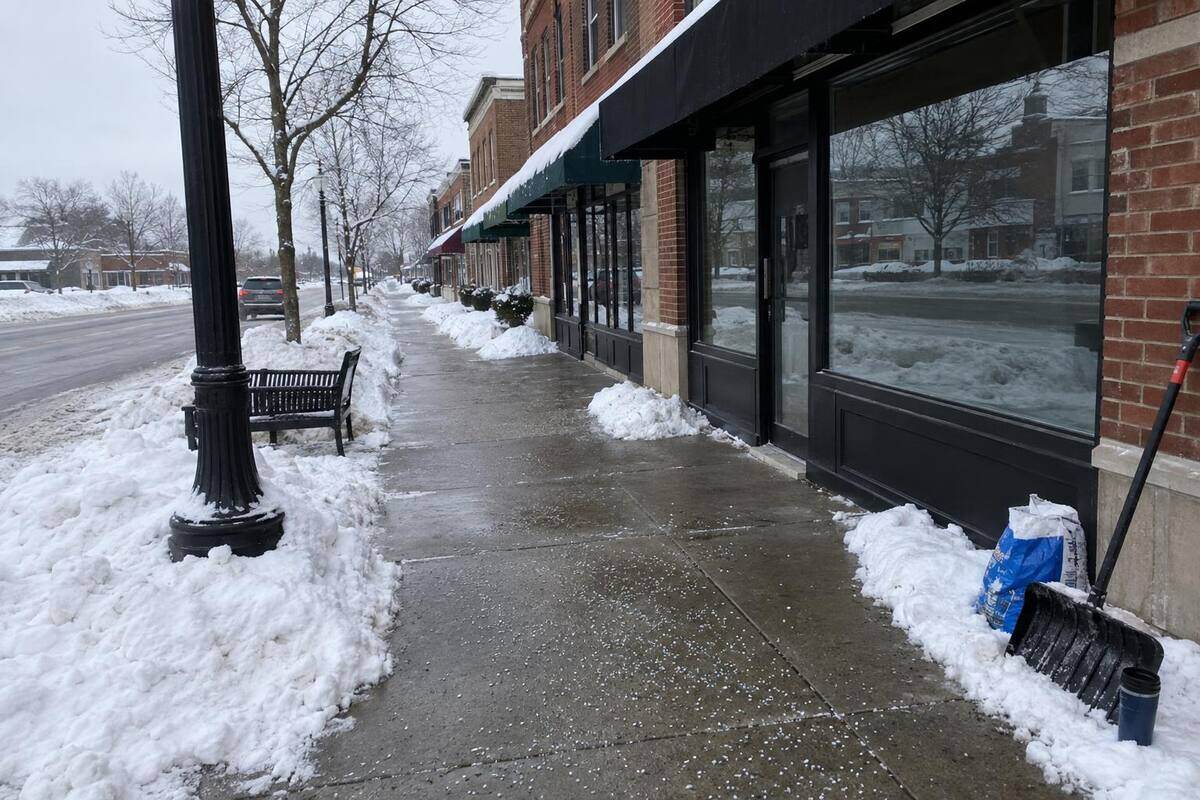
Illinois’ Snow and Ice Removal Act (745 ILCS 75) declares it state policy that residents be encouraged to clear the sidewalks in front of their homes, and shields any residential owner or occupant — and “any agent of or other person engaged by” them — from liability for injuries on a sidewalk they cleared, unless the conduct was willful or wanton. The hired shoveler is covered on the public walk.
Two court decisions narrow it, and both matter here. In Murphy-Hylton v. Lieberman Management Services (2016) the Illinois Supreme Court held the immunity covers negligent removal efforts, not ice that formed because of a drainage or maintenance defect. In Hussey v. Chase Manor (2018) the appellate court read “sidewalks abutting the property” to mean the public walk at the lot line — not driveways, private walks or parking-lot paths. So the statute protects exactly the surface Barrington’s ordinance requires cleared, and none of the surfaces a contractor is usually paid to clear. On those, the ordinary rule applies: no duty for a natural accumulation, potential liability for an unnatural one — a pile that melts across a walk and refreezes, or a plowed ridge left where people walk. The sidewalk rules page.
Which village, what the driveway is like, and what else needs clearing. An operator who already runs that village will quote it in writing.
Call (224) 655-5981 Get a Seasonal Quote Barrington