A building code that requires ice shield at the eaves is a village telling you what its winters do to a roof. Here is what roof snow work is, what it is not, and when the eave over a walkout basement door deserves attention.
The plowing, shoveling and salting arranged through this page is done by an independent snow removal operator under their own business name and their own insurance. This site makes the introduction and clears nothing itself.
Barrington Hills’ adopted residential code amends the climate table to say what the village expects of a roof: a ground snow load of 30 psf, a 42-inch frost line, a winter design temperature of −4°F, and ice-shield underlayment: yes. A village does not require ice barrier at the eaves unless ice dams are a known local failure. The weather station down the road explains why: 64 days a year with an inch or more of snow on the ground, and every winter month averaging three to four degrees colder than the city.
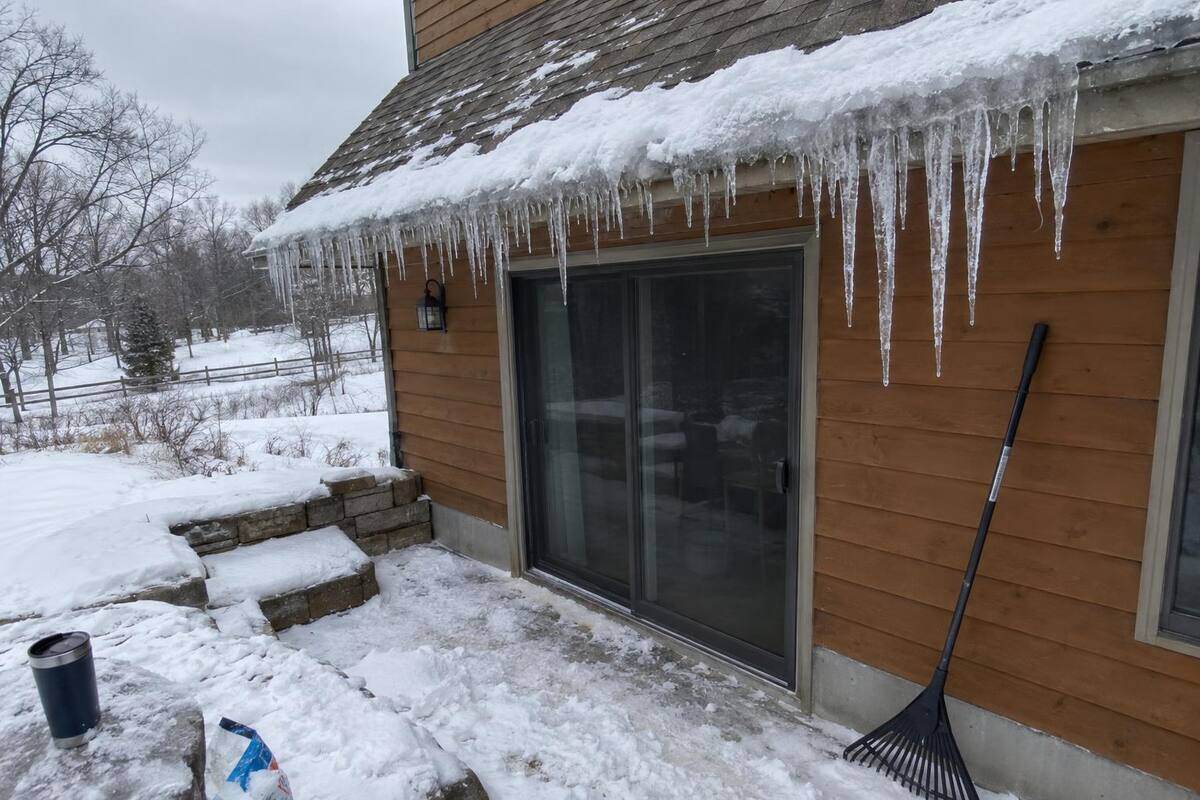
Add the housing. Nearly half of Barrington village’s homes were built before 1970, and Tower Lakes’ median house dates to 1965. Older attics leak heat; heat melts the roof snow from underneath; the water runs to the cold eave and refreezes into a dam, and the next melt backs up under the shingles. The Department of Energy’s building guidance notes an ice dam can form with as little as two inches of snow on the roof. In a market of full basements and walkouts, the water from one does not stop at the ceiling.
Pulling the first few feet of snow off the eave from the ground with a roof rake after a heavy fall, so there is less to melt and refreeze. Low-skill, low-risk, and the one most snow operators will add to a route on a big storm.
Steaming or carefully cutting an existing dam. This is specialist work — a hammer on a dam takes the shingles with it — and it is usually a roofing or restoration contractor, not a plow operator. The honest answer to “can you clear the ice dam” from most plow crews is a referral.
Air-sealing the attic floor, adding insulation and ventilating the roof deck. The Department of Energy lists those three as the fix. It is summer work, and it ends the problem rather than managing it.
No Barrington-area contractor publishes an ice dam price, and this site does not invent one. What can be said is that roof raking after a big storm is a normal add-on to a seasonal contract, and steaming a dam is a separate trade with a separate invoice.
At a 30 psf design load, an ordinary pitched roof in Barrington Hills is built for more snow than this area typically holds; 38.5 inches a season does not arrive all at once, and it settles. The storms that put a foot down — November 29–30, 2025 left 11.1 inches on Barrington — are the ones where a flat or low-slope section, a porch roof, a barn roof or a roof that has already iced at the drains deserves a look. Wet snow is the heavy kind. The freezing rain that came through on February 22–23, 2023, with 0.15 to 0.34 inches of ice on Lake and McHenry counties and more than 111,000 outages, is the other case: ice plus snow on top of it.
Two things do not need a contractor: knowing that a roof rake exists, and knowing that the walkout side of a house, where the eave sits over a patio door and a stairwell to the basement, is where a dam does the most damage.
Which village, what the driveway is like, and what else needs clearing. An operator who already runs that village will quote it in writing.
Call (224) 655-5981 Get a Seasonal Quote Barrington